



Table of Contents
- What is the UAE R&D tax credit?
- How much is the R&D tax credit in the UAE?
- Worked example: a Dubai software company
- Who can claim the R&D tax credit?
- What counts as qualifying R&D?
- Which R&D costs qualify for the credit?
- How do you apply for pre-approval on TAWWER?
- What is the R&D tax credit application timeline?
- How do you claim the credit in your tax return?
- What happens to unused credit?
- Can the FTA take the credit back?
- What should finance teams do in the remaining weeks of 2026?
- Get your R&D tax credit claim prepared and filed correctly
- Frequently asked questions
Last updated: 12 November 2026 | Reviewed by: M. A. Farahat, ACPA, CFE, CICA
Short answer: The UAE R&D tax credit is a non-refundable corporate tax credit of 15%, 35% or 50% of qualifying research and development spend, introduced by Cabinet Decision No. 215 of 2025 and Ministerial Decision No. 24 of 2026. It applies to tax periods starting on or after 1 January 2026 and covers qualifying spend up to AED 5,000,000 per tax period, which puts the credit at no more than AED 2,000,000 per company or tax group. Each R&D project needs at least AED 500,000 of qualifying spend and pre-approval from the Emirates Research and Development Council (ERDC) on its TAWWER platform. For 2026 projects with a 31 December year end, the pre-approval deadline is tentatively the end of February 2027.
The credit is tied to people as much as to money. The 50% rate only applies if your company has an average of at least 14 R&D staff during the period, and the 15% rate needs at least 2. The headcount includes your own R&D employees, externally provided workers under your direction and, for subcontracted R&D, the subcontractor’s staff who work directly on the project. If you outsource development, ask the subcontractor for monthly headcount records from the start, because you will need them to prove the average.
What is the UAE R&D tax credit?
It is a credit you deduct from your corporate tax bill, not a grant or a cash refund. The Ministry of Finance launched Phase 1 of the R&D Tax Incentives Programme on 18 March 2026, the same day Ministerial Decision No. 24 of 2026 set the rates. The legal framework sits in Cabinet Decision No. 215 of 2025, issued on 31 December 2025 under the Corporate Tax Law (Federal Decree-Law No. 47 of 2022), the UAE’s main direct tax.
The credit reduces corporate tax and, for large multinational groups subject to the UAE’s domestic minimum top-up tax, Top-up Tax. The Ministry of Finance says the non-refundable design takes the OECD Pillar Two rules into account and that Phase 2 may look at a refundable credit or wider qualifying spend. No date for Phase 2 has been announced.
Two bodies run the programme. ERDC reviews and pre-approves R&D projects. The Federal Tax Authority (FTA) receives the claim in your corporate tax return and can audit it, claw it back and apply penalties.
Tax Consultant Dubai
Expert tax advisory services in Dubai.
Get professional consultation from experienced tax specialists.
How much is the R&D tax credit in the UAE?
The rate depends on two tests applied together: how much qualifying R&D expenditure you have in the tax period, and the average number of R&D staff working on your qualifying R&D, which can include a subcontractor’s staff. Each rate applies only to the slice of spend inside its band.
| Qualifying R&D expenditure in the tax period | Minimum average R&D staff | Credit rate on that slice | Maximum credit from the slice |
|---|---|---|---|
| First AED 1,000,000 | 2 | 15% | AED 150,000 |
| AED 1,000,001 to AED 2,000,000 | 6 | 35% | AED 350,000 |
| AED 2,000,001 to AED 5,000,000 | 14 | 50% | AED 1,500,000 |
| Total | AED 2,000,000 |
Ministerial Decision No. 24 of 2026 gives no rate for spend above AED 5,000,000, so spend beyond that level earns no credit. For a tax group, the spend and staff of all qualifying members are added together and the bands apply once to the group, not to each member.
Both thresholds must be met for a rate to apply. In the words of Article 2(7), if either threshold is not met, “the R&D Tax Credit rate will be adjusted downward to the highest rate for which both thresholds are satisfied.” The average staff figure is the total of your monthly R&D staff counts divided by the number of months in which you carried out qualifying R&D. For subcontracted R&D, the count covers the full-time or full-time equivalent staff of both you and the subcontractor who work directly on the activity. For a cost contribution arrangement, it covers everyone working directly on the shared R&D.
Worked example: a Dubai software company
A Dubai mainland company with a 31 December year end develops a new machine-learning model for fraud detection. ERDC pre-approves the project. In 2026 it has an average of 16 R&D staff and these R&D costs:
| Cost | Amount (AED) |
|---|---|
| Salaries, allowances and benefits of R&D staff | 1,500,000 |
| 30% staff cost uplift for overheads | 450,000 |
| Consumables (software licence fees, materials used up in testing) | 250,000 |
| Subcontracted R&D by a UAE-based lab | 300,000 |
| Qualifying R&D expenditure | 2,500,000 |
The credit is AED 1,000,000 x 15% = AED 150,000, plus AED 1,000,000 x 35% = AED 350,000, plus AED 500,000 x 50% = AED 250,000, which gives AED 750,000.
The company’s taxable income for 2026 is AED 4,000,000, so its corporate tax is (AED 4,000,000 minus AED 375,000) x 9% = AED 326,250. The credit wipes out that bill. Because the credit is non-refundable, the remaining AED 423,750 does not come back as cash. It is carried forward to 2027 and later years, as long as the ownership condition described below is met.
Note that the R&D costs are still deducted in arriving at the AED 4,000,000 of taxable income. Qualifying R&D expenditure must be deductible expenditure, and the credit sits on top of the deduction.
Who can claim the R&D tax credit?
A qualifying entity is a company or other juridical person that is subject to UAE corporate tax and/or Top-up Tax and carries out qualifying R&D activities in the UAE. That includes free zone companies and foreign companies with a permanent establishment in the UAE. ERDC states that eligibility is based on the activity, not the sector, so a logistics company or a food manufacturer can qualify as readily as a technology firm.
To claim, the company must also bear the cost of the R&D, be entitled to the returns from exploiting the results, have a defined R&D objective and keep meeting the conditions throughout the project. For a tax group, the parent company applies for pre-approval and files the claim for the whole group.
These entities cannot claim:
- Entities that are not subject to corporate tax or Top-up Tax
- Entities that have elected Small Business Relief under Article 21 of the Corporate Tax Law
- Qualifying Free Zone Persons, unless the income from the R&D activity is taxed at 9% or the entity is subject to Top-up Tax for that year
The Small Business Relief exclusion matters for start-ups with revenue of AED 3,000,000 or less. You have to choose between treating the year as having no taxable income under the relief and claiming the R&D credit. Our article on Small Business Relief after the 2029 extension explains the relief. If you claim the R&D credit and then elect Small Business Relief within five years of your last claim period, Ministerial Decision No. 24 allows the FTA to claw back the credits you used and cancel the unused balance.
What counts as qualifying R&D?
An activity qualifies only if it is carried out in the UAE as part of an R&D project and meets all five tests below. Ministerial Decision No. 24 of 2026 requires activities to be assessed with reference to the OECD Frascati Manual.
| Test | What ERDC looks for |
|---|---|
| Novel | The work aims at new findings, knowledge or applications, not routine improvements |
| Creative | It is based on original, non-obvious concepts or hypotheses |
| Uncertain | The outcome cannot be known in advance, and the uncertainty is scientific or technical, not commercial |
| Systematic | The work is planned, budgeted and documented |
| Transferable or reproducible | The results can be documented and repeated or transferred |
R&D in the social sciences, humanities and the arts is excluded. A new feature that a competent developer can build with known methods fails the uncertainty test, even if it is new to your business. Building a model where no one yet knows whether the required accuracy can be reached passes it.
Which R&D costs qualify for the credit?
| Category | Included | Excluded |
|---|---|---|
| Staff costs | Salaries, wages, allowances, medical insurance, pension contributions, end-of-service gratuity, bonuses, benefits in kind and training for R&D staff based in the UAE, plus a 30% uplift for overheads. Externally provided workers under your direct control count. | Employee stock option plans, recharges from tax group members, the non-R&D share of part-time staff |
| Consumables | Materials used up in the R&D, water, fuel and power, licence fees and other non-capital intangible costs, payments to clinical trial participants | Items later sold in the ordinary course of business, items bought from a tax group member |
| Subcontracting | R&D work by a UAE-based subcontractor carried out in the UAE | Work done outside the UAE, work the subcontractor passes on to a third party, subcontracting within a tax group |
| Cost contribution arrangements | Your arm’s length share of joint R&D carried out in the UAE | The share relating to R&D outside the UAE |
Across all four categories, costs funded by a grant are excluded, as are costs that already receive another incentive, credit or relief. Where a related party carries out subcontracted R&D, the subcontractor must keep audited financial statements. The AED 500,000 minimum per project is measured before the 30% uplift, so a project with AED 400,000 of staff costs does not reach it even though the uplifted figure is AED 520,000.
How do you apply for pre-approval on TAWWER?
All pre-approval applications go through TAWWER, ERDC’s digital platform for the R&D tax credit. ERDC describes it as the single channel for submitting R&D projects. TAWWER does not file your tax return or calculate the final credit; that happens later in your corporate tax return.
- An individual authorised to act for the company signs in to TAWWER with UAE PASS, adds the company and enters its Tax Registration Number.
- The company’s authorised signatory registered with the FTA approves the access request.
- The representative starts a new application for each R&D project and completes the organisation, project, research, execution and budget sections. Expect to describe the knowledge gap and technical uncertainty, the planned methods, the R&D staff and their monthly time allocation, and the estimated qualifying spend by category.
- ERDC reviews the project against the five tests and the estimated spend. It can approve the project, approve it in part or reject it.
- If ERDC needs more detail, it sends a request for information through TAWWER. ERDC states that a request for information is not a rejection. You cannot freely edit a submitted application, but the FTA and ERDC timeline confirms that you can amend or withdraw it at any time before ERDC makes its determination.
ERDC does not publish a fixed review time. Its FAQ says review time depends on the application and the information provided, and you can track the status in TAWWER.
What is the R&D tax credit application timeline?
The Federal Tax Authority and ERDC have published a joint timeline that runs from the first application to the last day records must be kept. The graphic below sets out each deadline in order.
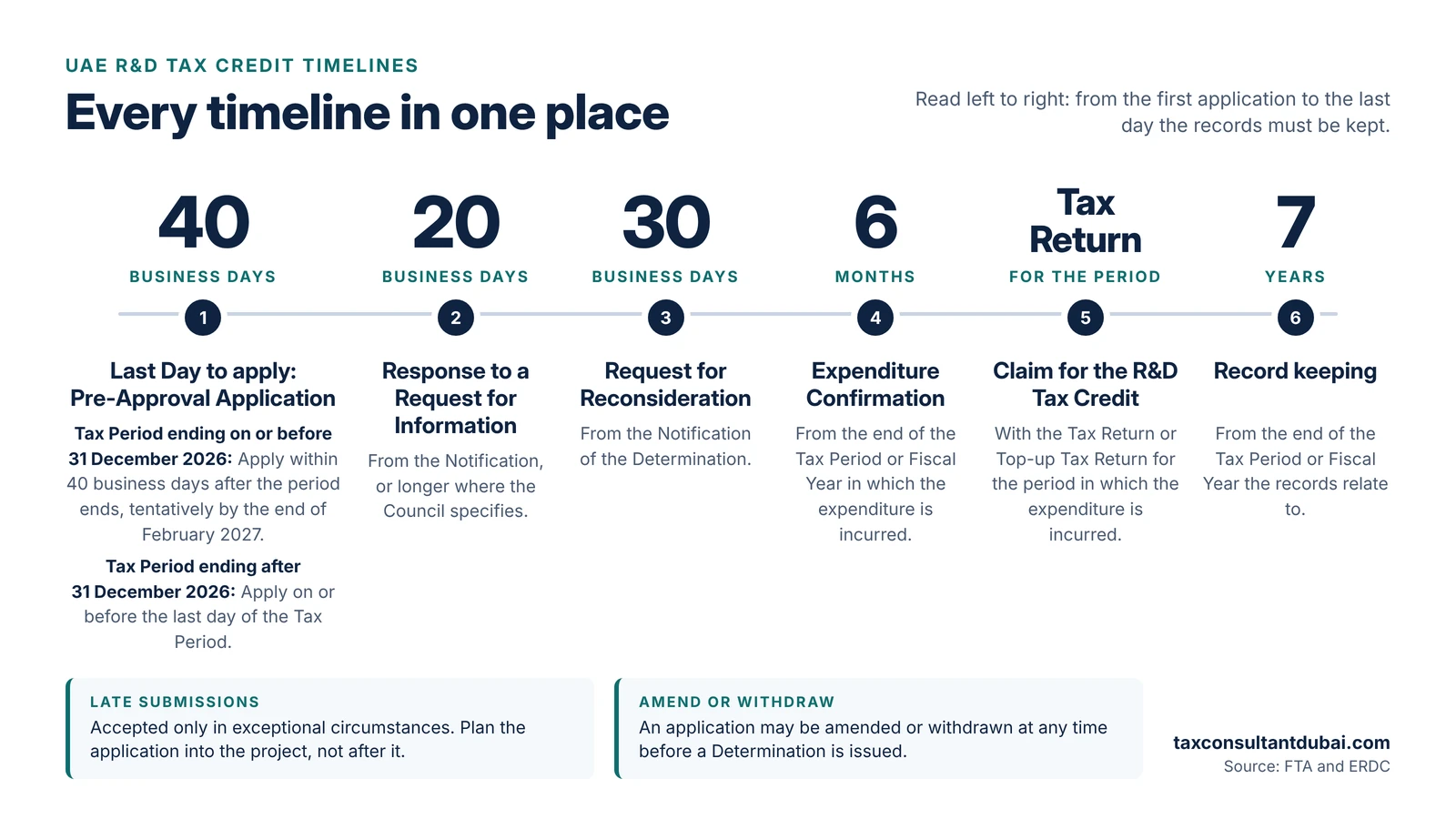
Late submissions are accepted only in exceptional circumstances, so build the application into the project plan rather than leaving it until the year closes.
The change after 2026 is the one to plan for. From the next tax period onwards, you must apply before your tax period ends, not after it. A project you only think of claiming once the books close will be too late.
Timeline for a company with a 31 December year end
| Date | 2026 tax period | 2027 tax period |
|---|---|---|
| Tax period | 1 January to 31 December 2026 | 1 January to 31 December 2027 |
| Pre-approval application due | Tentatively the end of February 2027 (40 business days) | 31 December 2027 |
| Actual spend confirmed in TAWWER | 30 June 2027 | 30 June 2028 |
| Corporate tax return and claim filed | 30 September 2027 | 30 September 2028 |
| Technical records kept until | 31 December 2033 | 31 December 2034 |
The FTA and ERDC describe the 2026 deadline as tentatively the end of February 2027. Counting Monday to Friday and excluding the 1 January 2027 public holiday, 40 business days ends on 26 February 2027, so treat that as the safe date and apply earlier if you can, leaving time to answer any request for information.
Companies with other year ends move to the stricter rule sooner. A company with a 30 June year end has its first eligible tax period from 1 July 2026 to 30 June 2027. That period ends after 31 December 2026, so the pre-approval application is due by 30 June 2027, before the period closes.
How do you claim the credit in your tax return?
- Track qualifying costs by project and R&D staff by month from the first day of the project, including the subcontractor’s staff where you outsource. You need the monthly headcount to prove the average staff threshold.
- Keep technical records of objectives, methods, experiments and findings for seven years after the end of the tax period, as Ministerial Decision No. 24 requires.
- Have your financial statements audited. Cabinet Decision No. 215 requires audited statements with the claim.
- File the claim in the corporate tax return for the period in which you incurred the spend, with proof of ERDC pre-approval, a declaration signed by senior management and a breakdown of the expenditure. Late claims are not accepted except in exceptional circumstances.
Our corporate tax return filing deadline guide shows the return due date for other year ends.
What happens to unused credit?
The credit is used against the tax for the year of the claim first, and older credits are used before newer ones. Unused credit can be carried forward with no time limit in the decisions, provided that either:
- the same shareholders held at least 50% of the company without a break from the start of the year the credit arose to the year it is used, or
- after a change of more than 50% in ownership, the company continues the same or a similar business, judged under Article 39(2) of the Corporate Tax Law.
This ownership condition does not apply to companies listed on a recognised stock exchange. A company can also transfer unused credit to another taxable company where there is 75% shared ownership between them. The receiving company must use it in the same tax period and cannot carry it forward or pass it on.
Can the FTA take the credit back?
Yes. If a company stops meeting the conditions for a project, credits already used must be repaid and unused credits for that project are cancelled. No losses or other reliefs can be set against the repayment, and the amount counts as tax due for penalty purposes. Our page on corporate tax penalties in the UAE sets out how those penalties work.
The same clawback applies within five years of the last claim period if the company stops being a taxable person, becomes a Qualifying Free Zone Person, elects Small Business Relief, goes into liquidation or moves its domicile out of the UAE. The FTA can also counter arrangements set up mainly to obtain or increase the credit, including the artificial separation of a business.
What should finance teams do in the remaining weeks of 2026?
The first eligible period for a calendar-year company is the year ending 31 December 2026, so the records for that claim are being created now. Four checks are worth doing before the year closes.
First, set up TAWWER access through UAE PASS and your FTA authorised signatory now, so the end-of-February 2027 pre-approval deadline for 2026 projects is not squeezed. Second, list the projects that pass all five tests and confirm each one has AED 500,000 or more of qualifying spend before the uplift. Third, pull your monthly headcount of R&D staff for 2026 and work out the average, since it decides which rates you can reach. Fourth, compare the credit against Small Business Relief if your revenue is AED 3,000,000 or less, and against your free zone status if you are a Qualifying Free Zone Person, because either one can block the claim.
Get your R&D tax credit claim prepared and filed correctly
Our FTA-registered tax agents test your projects against the five ERDC criteria, prepare your TAWWER pre-approval application before the deadline, map your staff, consumable and subcontracting costs to the qualifying categories, calculate the credit band by band and include the claim in your corporate tax return on EmaraTax. If your business is near the AED 3,000,000 Small Business Relief line or is a free zone company, we model which position leaves you better off before you commit. Find out more about our corporate tax advisory service and corporate tax return filing service, or book an R&D tax credit review with our team.
Tax Consultant Dubai
Expert tax advisory services in Dubai.
Get professional consultation from experienced tax specialists.
Frequently asked questions
Sources: Emirates Research and Development Council, UAE R&D Tax Credit; ERDC, TAWWER platform; ERDC, FAQs; Ministry of Finance, Phase 1 of the R&D Tax Incentives Programme; Cabinet Decision No. 215 of 2025 on Research and Development Tax Credit; Ministerial Decision No. 24 of 2026; UAE Government Portal, tax incentives for innovation-driven businesses.
