
E-Invoicing Implementation in the UAE
FTA-Registered & Regulated Tax Agent
Get your data, your provider and your people ready for e-invoicing
Most businesses we talk to about e-invoicing start the same way: “our accountant mentioned something about this.” That’s usually the first sign a legal obligation is being treated like a software update. It isn’t one. From 1 January 2027, a PDF stops being a valid invoice for the largest UAE businesses, and every other business follows on 1 July 2027. We help you get the data, the provider and the people ready, so the switch-over is a non-event instead of a month of rejected invoices.
- ✓ Your phase and deadline confirmed, entity by entity
- ✓ Accredited Service Providers shortlisted for your ERP
- ✓ Invoice data mapped to PINT AE and tested before go-live
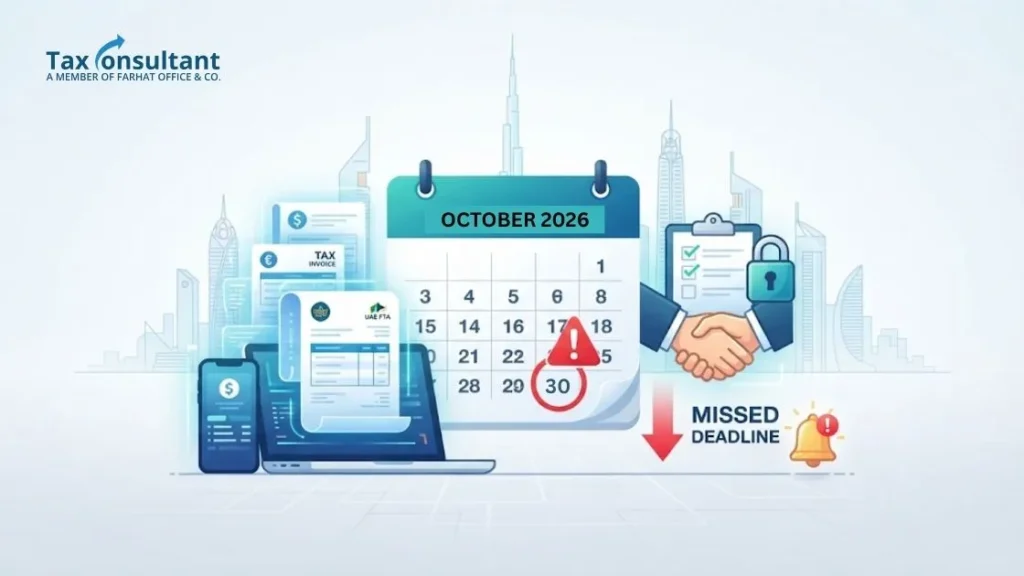
Phase 1 go-live – 1 January 2027: The ASP appointment deadline for businesses with revenue of AED 50 million or more passed on 30 October 2026. Missed it? Under Cabinet Decision No. 173 of 2026 the penalty is AED 5,000, then AED 5,000 for each further month or part of a month, up to AED 50,000 in any 12 months. Phase 2 (under AED 50 million): appoint your ASP by 31 March 2027.
FREE CONSULTATION
UAE E-Invoice Implementation Timeline
Know Your Deadline — And Start Before It
The UAE’s phased e-invoicing mandate has hard deadlines. Here is where your business falls and what you need to do — and by when.
| Phase | Applicable Entities | ASP Appointment Deadline | Mandatory Go-Live | Status |
|---|---|---|---|---|
| Phase 1 | Annual revenue ≥ AED 50 million | 30 Oct 2026 | 1 Jan 2027 | ASP deadline passed |
| Phase 2 | Annual revenue < AED 50 million | 31 Mar 2027 | 1 Jul 2027 | Plan now |
| Phase 3 | Government entities | 31 Mar 2027 | 1 Oct 2027 | Assess now |
* Your phase depends on gross revenue in your most recent accounting period, per entity, taken from your financial statements. Voluntary use has been open since 1 July 2026, and penalties only apply from your mandatory date. B2C transactions are excluded, along with limited exclusions such as certain financial services, some airline transactions and, for 24 months from 1 January 2027, transactions within the same VAT tax group. Rule of thumb: if you already need audited financial statements for Corporate Tax because revenue is over AED 50 million, assume you are Phase 1.

UAE E-Invoicing Timeline: Key Dates to Know
The rollout is happening in phases based on business size. Here is where things currently stand:
- 1 July 2026 – Voluntary phase opened. Businesses of any size can go live early to test their systems and identify gaps.
- 30 October 2026 (passed) – ASP appointment deadline for businesses with annual revenue of AED 50 million or more.
- 1 January 2027 – Mandatory e-invoicing goes live for businesses with annual revenue of AED 50 million or more.
- 31 March 2027 – ASP appointment deadline for businesses with annual revenue below AED 50 million, and for government entities.
- 1 July 2027 – Mandatory e-invoicing goes live for businesses with annual revenue below AED 50 million.
- 1 October 2027 – Mandatory e-invoicing goes live for government entities (B2G).
At present, the mandate covers B2B and B2G transactions. B2C invoices are excluded for now, along with a small number of specific categories such as certain government acts and select financial services.
Waiting until your mandatory date arrives is not a sound strategy. ERP changes, staff training, and ASP onboarding all take time, and the voluntary window is the lowest-risk opportunity to get it right before penalties apply.
Missed the 30 October ASP Deadline? Here’s What to Do Now
If your revenue is AED 50 million or more and you haven’t appointed an ASP, you are exposed to penalties under Cabinet Decision No. 173 of 2026: AED 5,000, then AED 5,000 for each further month or part of a month, capped at AED 50,000 in any 12 consecutive months. The fine is the smaller problem. The bigger one is that you still have to be sending valid PINT AE invoices on 1 January 2027, and the time to get there is now very short.
Here’s what we do with late Phase 1 clients:
- Appoint an ASP this week. We shortlist accredited providers that already connect to your ERP, so onboarding takes days, not weeks.
- Fix the data before the connection. Most go-live rejections come from missing mandatory fields, not software failures. We map your invoice data against the FTA Data Dictionary while the ASP builds the integration.
- Test the hard cases first. Advance and final invoice linking, credit notes and retention billing go through testing before standard invoices, because these cause rejections in week one.
- Get your finance team ready for 1 January. We train them on what to do when the ASP rejects an invoice.
Appointed an ASP but not sure you’ll be ready? We also run pre-go-live reviews for businesses that appointed on time but haven’t tested yet. For a week-by-week plan, read our six-week fix plan for a missed ASP deadline.
What We’re Seeing Businesses Get Wrong
A handful of patterns keep showing up, regardless of company size:
- Treating it as an IT ticket. Finance teams hand the project to IT, IT picks a software vendor, and nobody checks whether that vendor is actually an accredited service provider under the Ministry’s rules. It isn’t optional, and it isn’t a preference. Only an Accredited Service Provider (ASP) can legally transmit your e-invoices to the FTA.
- Assuming a PDF invoice with a nice layout still counts. It won’t. Once your business is in scope, only a structured XML file built to the PINT AE standard is a valid tax invoice. A well-formatted PDF has zero compliance value under the new system.
- Treating the ASP appointment as the finish line. Many businesses rushed to sign an ASP before 30 October and then stopped. Appointment is step one. Your data mapping, integration and testing still need to be finished before 1 January 2027, and none of it can wait until the last week.
- Missing the advance and final invoice linking rules. Under the latest rulebook, advance payments have to be recorded in the “Paid Amount” field and referenced back to the original invoice. Miss this and your invoice gets rejected, not just flagged.
- Not accounting for retention billing. If you’re in real estate or contracting, the rules on how much VAT to show at each billing stage changed. Getting this wrong on a large contract is expensive to unwind later.
- Thinking “not VAT-registered” means “not in scope”. The Ministry’s guidelines put anyone conducting business in the UAE in scope, whatever their VAT registration status, for B2B and B2G sales.
- Forgetting the buyer side. Your company must also receive e-invoices through the system. You appoint one ASP that handles both sending and receiving.
If any of these sound familiar, that’s the actual starting point for our e-invoicing advisory, not a generic readiness checklist.
Where Your Business Actually Stands Right Now
Before we recommend anything, we place your business on the real timeline, not a generic one:
- Revenue of AED 50 million or more, ASP appointed: Your go-live is 1 January 2027. The question now is whether your data and testing will be ready in time.
- Revenue of AED 50 million or more, no ASP yet: You’re past the deadline and exposed to penalties. Appointing now limits the damage. See the section on missing the 30 October deadline above.
- Revenue below AED 50 million: You’re in Phase 2. Appoint your ASP by 31 March 2027 and go live by 1 July 2027. Start now and you can test properly instead of rushing.
- Government entity: Appoint your ASP by 31 March 2027 and go live by 1 October 2027.
- B2C only: You’re outside the mandate for now. The Ministry can bring B2C into scope by a later decision, so it’s worth reviewing again.
We tell clients honestly when they have time to plan properly and when they don’t. That distinction changes the entire approach.
What Changed on 1 October 2026
Two Ministerial Decisions came into force on 1 October 2026 and changed the practical picture.
Ministerial Decision No. 197 of 2026 amended the core e-invoicing rules:
- Transactions between members of the same VAT tax group are excluded for 24 months from 1 January 2027.
- E-invoice data no longer has to be stored inside the UAE. You must still keep it for the period set by the Tax Procedures Law and produce it to the FTA on request.
- The duty to notify the FTA of a system failure within two business days was repealed. Your invoicing deadlines still apply, so you need a fallback plan.
- The deadline for issuing certain e-invoices was revised to 14 business days from the transaction date. We check which deadline applies to each of your invoice types.
Ministerial Decision No. 168 of 2026 replaced the ASP accreditation rules and removed the pre-approval stage. Accredited providers must be Peppol-certified and pass the OpenPeppol conformance tests, run a product that has been in operation for at least two years, hold ISO/IEC 27001 (for the product) and ISO 22301 (for the provider), carry professional indemnity, crime and cyber fraud insurance, and give each client 100 free e-invoice exchanges a year.
E-Invoicing Penalties Under Cabinet Decision No. 173 of 2026
Cabinet Decision No. 173 of 2026 replaced Cabinet Decision No. 106 of 2025. The Ministry’s guidelines say penalties only apply from the date you’re mandatorily in scope.
| Violation | Penalty | Cap |
|---|---|---|
| Not implementing the system, including no ASP by your deadline (or a recipient that stops meeting its obligations) | AED 5,000, then AED 5,000 for each further month or part of a month | AED 50,000 in any 12 consecutive months |
| E-invoice not issued and transmitted | AED 100 per invoice | AED 5,000 per calendar month |
| E-credit note not issued and transmitted | AED 100 per credit note | AED 5,000 per calendar month |
| Not telling your ASP about changes to your data registered with the FTA | AED 250 per day or part of a day | AED 5,000 per calendar month |
The old penalty for not reporting a system failure to the FTA was removed, and only one penalty applies where the same business is both issuer and recipient for the same violation.
How Our E-Invoicing Advisory Actually Works
We don’t hand you a document and wish you luck. Here’s what working with us looks like in practice:
We start by mapping your current invoicing reality. Not your org chart, your actual invoice flow, from the moment a sale happens to the moment the invoice lands with your customer. This tells us exactly where the gaps are before we recommend a single tool.
We help you choose an ASP that fits your business, not a generic shortlist. ASP accreditation now comes with real requirements, including a minimum two-year track record, so we narrow the field to providers who actually match your ERP setup and transaction volume.
We get into the data, field by field. The Ministry’s mandatory field requirements are unforgiving. We map your invoice data against every mandatory field so nothing gets rejected on go-live day because of a missing tax breakdown or an incorrectly formatted seller reference.
We test before you’re forced to. Advance and final invoice linking, credit notes, retention billing scenarios, we run these through before your first live transaction, not during it.
We train the people who will actually run this day to day. Your finance team needs to know what to do when the ASP flags an error, not just how the system is supposed to work when everything goes right.
We stay on it as the rules change. The FTA has already updated its rulebook once since the mandate was announced. As new guidance lands, we flag what it means for your business specifically.

Why Businesses Bring in E-Invoicing Experts Instead of Going It Alone
E-invoicing sits in an unusual spot. It looks like a systems project, but it’s governed like a tax filing obligation, with penalties attached under Cabinet Decision 106 of 2025 once your mandatory date passes. That combination is exactly why businesses that try to run this purely through their IT department tend to hit compliance issues later, not technical ones.
Our advisors work through both sides of that at once. We know the FTA’s expectations because we deal with the FTA on tax matters regularly, and we know how to translate that into a system your finance team can actually run without you standing over their shoulder.
The same invoice data will now feed your VAT return and support your Corporate Tax revenue figure, so mismatches show up without an audit.
E-Invoicing UAE FAQs
Is e-invoicing mandatory in Dubai and the UAE?
Does e-invoicing apply if my business is not VAT-registered?
Can I keep sending PDF invoices?
What does it cost if we miss the ASP deadline?
Do I need an ASP to receive invoices too?
Is our accounting software approved?
Do invoices between our group companies count?
Does e-invoicing apply to freelancers and small businesses?
Related Blogs
 November 6, 2026
Missed the UAE E-Invoicing ASP Deadline? Six-Week Fix Plan
Short answer: Businesses with revenue of AED 50 million or more had to appoint an Accredited Service Provider...
Read Article