


Table of Contents
- Can stolen crypto be traced?
- What types of crypto fraud are traced in the UAE?
- How does crypto tracing work, step by step?
- Who regulates crypto businesses in the UAE?
- What do Dubai crypto businesses have to record?
- What are the red flags of crypto money laundering?
- How fast can funds be frozen in the UAE?
- What should you do in the first 48 hours after a crypto fraud?
- What makes crypto tracing evidence hold up?
- What should businesses do to prevent crypto fraud losses?
- How our forensic team helps
- Frequently Asked Questions
Last updated: 19 November 2026 | Reviewed by: M. A. Farahat, ACPA, CFE, CICA
Short answer: Stolen or misappropriated crypto can usually be traced, because every transaction sits on a public blockchain. The trail leads to a person once the funds reach a regulated exchange or service provider that holds customer identity records. In Dubai, licensed virtual asset service providers must collect sender and recipient details on transfers above AED 3,500 and report suspicious transactions to the UAE Financial Intelligence Unit (FIU) through goAML. Speed decides the outcome: the UAE FIU can freeze suspected funds for 30 days, and courts can grant freezing orders, but only if the funds are found before they are moved on.
Crypto fraud cases rarely stay on the blockchain. Funds move from a wallet to an exchange, into a bank account, and out into property, shares or another company. A tracing exercise follows the money across all of those steps, and the strongest cases combine blockchain evidence with ordinary forensic accounting. This guide explains how that works in the UAE, which rules apply, how funds can be frozen, and what victims and businesses should do.
Can stolen crypto be traced?
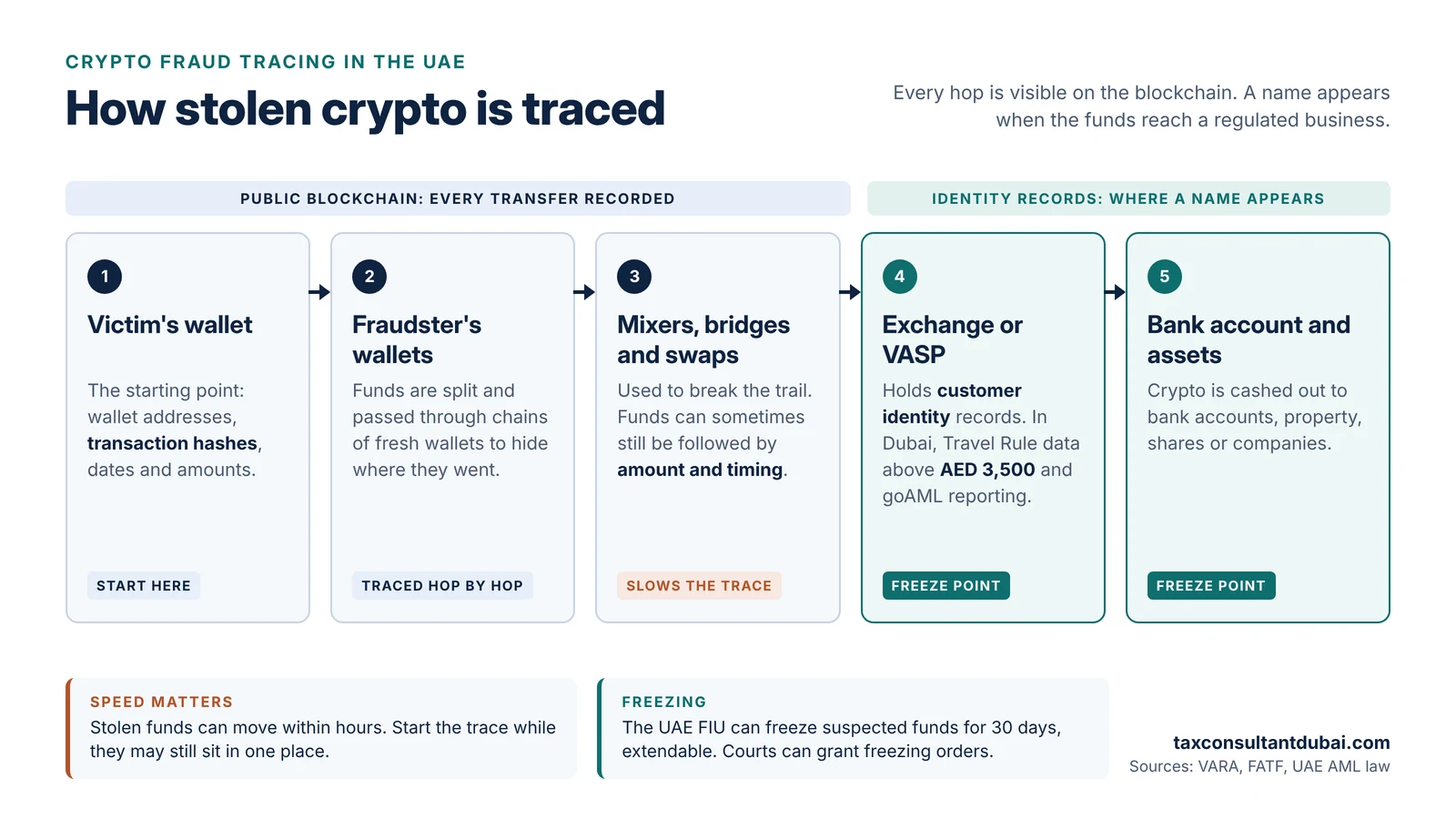
Yes, in a large share of cases. A public blockchain records the sending address, the receiving address, the amount and the time of every transaction, and that record cannot be edited after the fact. Anyone can read it, which means an investigator can follow funds from the victim’s wallet through each later transfer, even years after the event.
What the blockchain does not show is who controls an address. Addresses are pseudonymous: a string of letters and numbers with no name attached. The link to a real person usually comes from outside the blockchain, for example:
- an exchange account opened with a passport, Emirates ID or company documents
- a bank transfer used to buy the crypto or to cash it out
- a payment to a merchant who knows the customer
- an IP address, email address or phone number held by a service provider
- a phone, laptop or hardware wallet seized by police
That is why tracing aims to find the point where the funds touch a regulated business. Once that business is identified, police, the FIU or a court can require it to hand over its records.
Tax Consultant Dubai
Expert tax advisory services in Dubai.
Get professional consultation from experienced tax specialists.
What types of crypto fraud are traced in the UAE?
| Type of fraud | How it usually works | Where the trail tends to lead |
|---|---|---|
| Investment scams | Victims are persuaded, sometimes over weeks of messaging, to invest in a platform that shows fake profits. Withdrawals are blocked or need “fees” first. | Wallets controlled by the scammers, then exchanges used to cash out |
| Unlicensed platforms | A firm offers trading, staking or deposits without a licence, then stops paying out. VARA publishes a list of entities it suspects or has found to be operating without the required licence. | Platform wallets, company bank accounts, related companies |
| Payment redirection | A hacked or spoofed email asks a business to pay a supplier or settle an invoice to a new wallet address. | A fresh wallet that quickly forwards the funds |
| Insider misappropriation | An employee, director or custodian with access to company wallets or private keys moves funds for personal use. | Personal wallets and exchange accounts linked to the insider |
| Diversion of reserves or investor funds | Money raised from investors or held as reserves is sent somewhere other than agreed. | Bank accounts and companies, as in the DIFC case discussed below |
Each of these leaves a different pattern on the blockchain, so the first job in any investigation is to understand exactly how the money left the victim’s control.
How does crypto tracing work, step by step?
| Step | What the investigator does |
|---|---|
| 1. Fix the starting point | Record the victim’s wallet addresses, transaction hashes (the unique ID of each blockchain transaction), dates, amounts and every message or invoice that led to the payment. |
| 2. Follow the transactions | Trace each transfer forward, transaction by transaction, using blockchain analytics tools that group addresses likely controlled by the same person or business. |
| 3. Identify service providers | Spot addresses that belong to exchanges, payment processors, custodians or other virtual asset service providers, where identity records exist. |
| 4. Deal with obfuscation | Account for mixers, cross-chain bridges, swaps between tokens and long chains of fresh wallets, which are used to break the trail. |
| 5. Bridge to fiat | Follow the money out of crypto into bank accounts, cards, cash or assets, using bank statements, accounting records and company filings. |
| 6. Prepare evidence | Produce a report and transaction flow chart that a lawyer, police unit or court can rely on, explaining the method and its limits. |
What makes tracing harder?
The Financial Action Task Force (FATF), the global standard-setter on money laundering, lists technology that increases anonymity as a red flag. Its examples include peer-to-peer trading platforms, mixing or tumbling services and privacy-enhanced cryptocurrencies. Fraudsters also hop between blockchains, swap one token for another and spread funds across hundreds of wallets.
These techniques slow tracing but do not always stop it. Funds that pass through a mixer or bridge can sometimes still be followed by amount and timing, and the person behind them still needs a regulated off-ramp to spend the money in the real economy. That off-ramp is usually where the case is won.
Why speed matters
Fraudsters move stolen crypto quickly, sometimes within hours, because they know exchanges and authorities can act once funds land somewhere identifiable. A trace that finds funds sitting on an exchange today may find them gone next week. Starting the trace early gives your lawyer the chance to ask the exchange, the FIU or a court to freeze them while they are still in one place.
Who regulates crypto businesses in the UAE?
Knowing which regulator covers a provider tells you whose rules it follows and where to check its licence.
| Regulator | Where it applies |
|---|---|
| Virtual Assets Regulatory Authority (VARA) | Dubai, mainland and free zones, except the Dubai International Financial Centre (DIFC). VARA was set up under Dubai Law No. 4 of 2022. |
| Securities and Commodities Authority (SCA) | Federal regulator that licenses virtual asset service providers under Cabinet Resolution No. 111 of 2022, except firms licensed in the financial free zones. SCA and VARA keep a unified register of licensed providers. |
| Dubai Financial Services Authority (DFSA) | Virtual asset activities inside the DIFC |
| Financial Services Regulatory Authority (FSRA) | Virtual asset activities inside Abu Dhabi Global Market (ADGM) |
Before you send money to any crypto platform, check VARA’s public register, or the register of the relevant regulator, and VARA’s list of unlicensed virtual asset service providers. VARA warns that dealing with unlicensed providers exposes consumers and investors to serious financial risks, including fraud and loss of assets. Names on its list include JPEX and OPNX.
What do Dubai crypto businesses have to record?
Regulated providers are where a trail turns into a name, so their records matter. VARA sets these duties in its Compliance and Risk Management Rulebook:
| Requirement | What VARA’s rulebook says |
|---|---|
| Travel Rule: sending | Before sending a transfer above AED 3,500, the provider must obtain and hold originator and beneficiary information and make it available to VARA on request (Rule III.G.2). |
| Travel Rule: receiving | Before giving a client access to received virtual assets above AED 3,500, the receiving provider must hold the required originator and beneficiary information (Rule III.G.3). |
| Minimum information | Originator: name, account number or wallet address, and residential or business address. Beneficiary: name and account number or wallet address (Rules III.G.4 and III.G.5). |
| Structuring | Providers must watch for transfers split up to stay under the thresholds and bypass the Travel Rule (Rule III.G.9). |
| Suspicious transactions | Staff report suspicions to the money laundering reporting officer (MLRO), who must report to the UAE FIU through goAML and answer follow-up requests from the FIU or VARA within 48 hours (Rules III.F.1, III.F.3 and III.F.4). |
| Monitoring | Providers screen transactions and wallet addresses, may use distributed ledger analytics tools, document what those tools can and cannot do, and design monitoring on the basis of FATF red flag indicators (Rules III.B.3 and III.C). |
| Unlawful conduct | Providers should immediately report any finding of unlawful conduct to VARA (Rule VI.F.2). |
For a fraud victim, these rules mean a Dubai-licensed exchange that received the funds should hold identity and transfer records that police, the FIU or a court can obtain.
What are the red flags of crypto money laundering?
FATF’s 2020 report on virtual asset red flag indicators groups them into six categories. Businesses, banks and auditors can use them to spot trouble early:
| FATF category | What it looks like |
|---|---|
| Anonymity-enhancing technology | Peer-to-peer platforms, mixers or tumblers, privacy-enhanced coins |
| Geographic risk | Funds routed through countries with weak or no rules for virtual assets |
| Transaction patterns | Activity that is irregular or unusual for the customer |
| Transaction size and frequency | Amounts or frequency with no sensible business reason |
| Sender or recipient profile | Behaviour by the parties that departs from what you would expect |
| Source of funds or wealth | Funds or assets that may come from criminal activity |
VARA’s rulebook expects licensed providers to build these indicators into their monitoring scenarios and thresholds.
How fast can funds be frozen in the UAE?
Through the UAE FIU
The UAE anti-money laundering law, Federal Decree-Law No. 10 of 2025, replaced Federal Law No. 20 of 2018. Under the new law, the UAE FIU can:
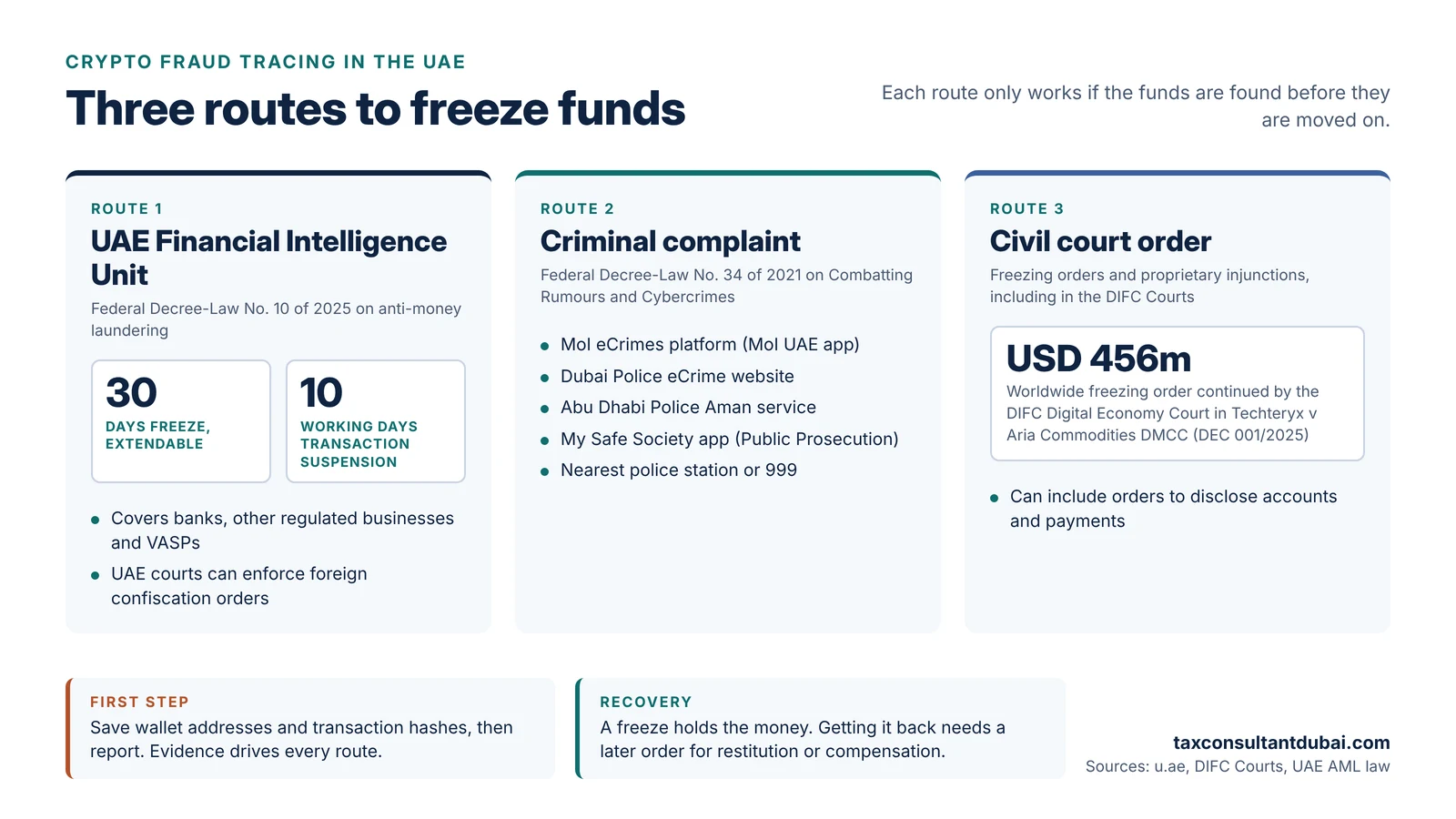
- freeze suspected funds held by financial institutions, designated non-financial businesses and virtual asset service providers for 30 days, a period that can be extended
- suspend suspected transactions for up to 10 working days without prior notice
The law also covers virtual assets and digital systems as methods of committing money laundering and terrorist financing offences, and allows UAE courts to enforce foreign orders for provisional measures or confiscation without a separate UAE money laundering investigation. That matters in crypto cases, where the victim, the fraudster and the exchange are frequently in different countries.
Through the criminal route
Electronic fraud is a crime under Federal Decree-Law No. 34 of 2021 on Combatting Rumours and Cybercrimes, in force since 2 January 2022. A criminal complaint brings in the police and Public Prosecution, which can trace funds and ask service providers for records. The official reporting channels are listed in the 48-hour steps below.
Through the civil courts
Civil courts can act too, and the leading UAE example shows what a tracing case looks like in practice. In Techteryx Ltd v Aria Commodities DMCC (DEC 001/2025), the DIFC Courts’ Digital Economy Court continued a worldwide freezing order and a proprietary injunction, each capped at USD 456 million. The claim concerns alleged diversion of the reserves backing the TrueUSD stablecoin to a Dubai company in six remittances between May 2021 and March 2022.
Three points from the case are worth noting:
- The court noted that the Dubai company could not show precisely how the money was used, what assets were bought or what became of them.
- The court observed that identifying and freezing the money is only a first step. Recovery needs a later order for restitution or compensation.
- In 2026 the court ordered sworn disclosure about payments, the sources of the funds and an undisclosed bank account, and it said that funds derived from the USD 456 million could not be used without the court’s permission.
Although the case began with a stablecoin, the bulk of the tracing happened in bank accounts and company records. That is typical: crypto tracing and forensic accounting are two halves of the same job.
What should you do in the first 48 hours after a crypto fraud?
- Stop all further payments to the suspected fraudster, including “fees” or “taxes” to release your funds, which are a frequent follow-up scam.
- Save the evidence: wallet addresses, transaction hashes, screenshots with dates, emails, chat logs, website addresses, app names and bank transfer records. Do not delete apps, chats or accounts, and do not reset the device.
- Report the crime. The UAE government lists these channels: the Ministry of Interior’s eCrimes platform in the MoI UAE app, the Dubai Police eCrime website, the Abu Dhabi Police Aman service, the Public Prosecution’s My Safe Society app, the nearest police station, and 999.
- Contact the exchange you sent funds from, and any exchange the funds reached, give them the transaction hashes and ask them to flag the receiving accounts. Keep a record of every request and reply.
- Check whether the platform you dealt with appears on VARA’s list of unlicensed providers, and note the result for your complaint.
- Start a tracing report while the funds may still be in one place, so your lawyer can ask for a freezing order if needed.
- Be wary of “recovery agents” who contact you promising to get your money back for an upfront fee. Victims of one scam are frequently targeted again.
What makes crypto tracing evidence hold up?
A trace is only useful if a police officer, prosecutor or judge can follow and trust it. A good tracing report:
- lists every transaction hash relied on, so anyone can check it on the public blockchain
- separates what the blockchain proves from what is inferred, for example that two addresses are controlled by the same person
- explains which analytics tools were used and their limits, the same discipline VARA asks licensed providers to apply to their own tools
- identifies each exchange or provider reached, with the amount and date
- connects the crypto trail to bank and accounting records where the funds were converted
- keeps a clear record of how the evidence was collected and stored
Courts deal with competing explanations of where money went, as the DIFC case shows. A report that is transparent about method is harder to challenge.
What should businesses do to prevent crypto fraud losses?
Treat crypto like any other high-risk payment channel:
- Approve new wallet addresses through the same controls you use for new bank beneficiaries.
- Require two people to sign off on every crypto transfer, and limit who holds private keys.
- Confirm any change in payment instructions by phone on a number you already hold, never one in the email.
- Send a small test transfer to a new address and confirm receipt before sending the full amount.
- If you accept crypto, screen incoming wallets and keep records connecting each receipt to an invoice and a customer.
- Deal only with providers on a UAE regulator’s register.
- Reconcile crypto balances regularly, just as you would bank accounts, so missing funds are spotted quickly.
For regulated businesses, the duty goes further. Virtual asset service providers in Dubai need working Travel Rule processes, transaction monitoring and a goAML reporting route in place before an incident, not after it. VARA’s rulebook also requires investigation reports and summaries of remedial action to be kept for at least eight years after the remedial action is completed (Rule VI.C.3.g).
How our forensic team helps
Our team is led by a Certified Fraud Examiner. We trace funds across blockchains, exchanges, bank accounts and company records, and prepare evidence reports for lawyers, police and courts. For businesses, we investigate suspected internal misappropriation of crypto, review wallet and payment controls, and help virtual asset businesses build AML controls through our sister firm’s anti-money laundering compliance service. If you have lost funds or suspect fraud inside your business, contact us for a confidential consultation.
Tax Consultant Dubai
Expert tax advisory services in Dubai.
Get professional consultation from experienced tax specialists.
Frequently Asked Questions
Can stolen cryptocurrency be traced?
Can stolen crypto be recovered in the UAE?
Where do I report a crypto scam in the UAE?
How do I check if a crypto platform is licensed in Dubai?
What is the Travel Rule in Dubai?
Do UAE crypto exchanges report suspicious transactions?
Do mixers and bridges make crypto untraceable?
What are the red flags of crypto money laundering?
Is crypto fraud a crime in the UAE?
What evidence do I need for a crypto fraud investigation?
Who performs crypto tracing in the UAE?
Sources: VARA, Compliance and Risk Management Rulebook (Rules III.C, III.F and III.G); UAE Legislation, Federal Decree-Law No. 10 of 2025 on Anti-Money Laundering; DIFC Courts, Techteryx Ltd v Aria Commodities DMCC [2025] DIFC DEC 001; UAE Government Portal, Report cybercrimes online; UAE Government Portal, Law on Combatting Rumours and Cybercrimes; VARA, Unlicensed VASPs; VARA and SCA, unified register of regulated providers; FATF, Virtual Assets Red Flag Indicators (September 2020).
