
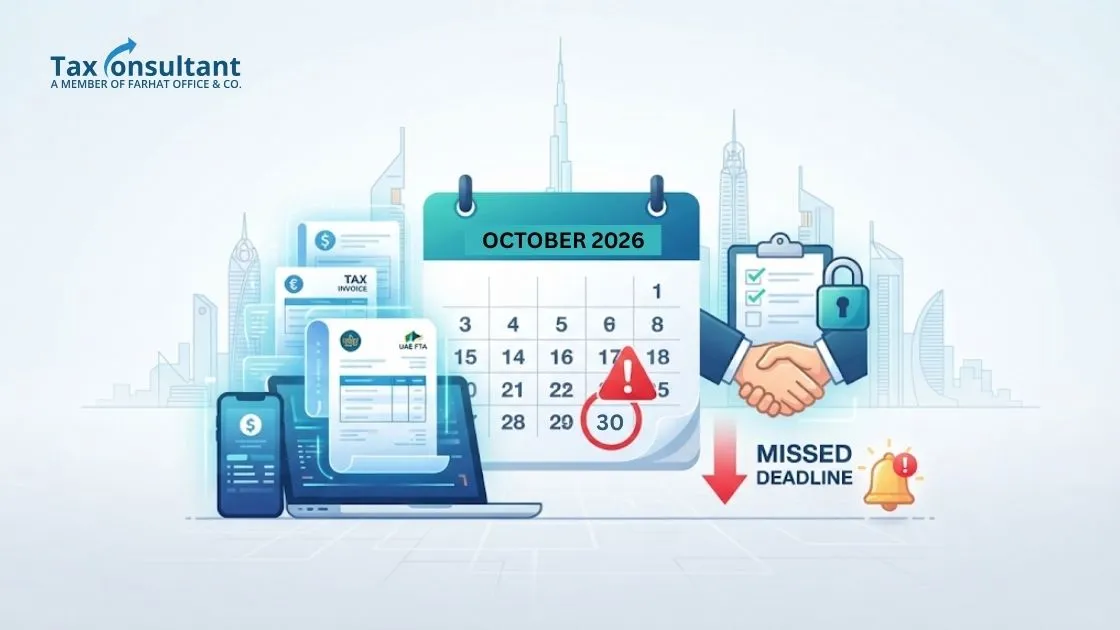


Short answer: Businesses with revenue of AED 50 million or more had to appoint an Accredited Service Provider (ASP) by 30 October 2026 under Ministerial Decision No. 244 of 2025, as amended by Ministerial Decision No. 66 of 2026. If you missed it, the 1 January 2027 go-live date has not moved. Cabinet Decision No. 173 of 2026 fines the failure AED 5,000 for the first instance plus AED 5,000 for each month or part month it continues, capped at AED 50,000 in any 12 consecutive months. Appoint through EmaraTax this month and use the six working weeks before the holidays to get live.
The mistake we are seeing this week is finance teams treating 1 January as the real deadline and 30 October as paperwork. The law treats them as two separate obligations, and the first one is already breached. The Ministry of Finance also closed the door on hope: when it moved the date from 31 July to 30 October, it called the change targeted and final and said no further extensions would follow. One piece of relief arrived on deadline day itself. A new penalty decision replaced the old one and capped the implementation fine. The cap only protects you if you go live, so the rest of this article is a week-by-week plan to do that.
Who had to appoint an ASP by 30 October 2026?
The test is revenue, not VAT registration. Ministerial Decision No. 244 of 2025 defines revenue as the gross income earned during the latest accounting period, based on financial statements prepared under UAE law or, where those are not available, other documentation the FTA accepts. A business that reached AED 50 million in its last accounting period is in Phase 1. A business that only makes business-to-consumer sales is outside the system until the Minister decides otherwise.
| Phase | Who | Appoint an ASP by | Go live by |
|---|---|---|---|
| Pilot and voluntary | Taxpayer working group and any business that opts in | No set date | From 1 July 2026 |
| Phase 1 | Revenue of AED 50 million or more | 30 October 2026 | 1 January 2027 |
| Phase 2 | Revenue below AED 50 million | 31 March 2027 | 1 July 2027 |
| Phase 3 | Government entities | 31 March 2027 | 1 October 2027 |
One detail to watch: the timeline table in the UAE Electronic Invoicing Guidelines version 2.0, dated 26 October 2026, shows 31 October 2026 as the Phase 1 appointment date. Ministerial Decision No. 66 of 2026 says 30 October 2026. The decision is the law, so plan from 30 October. Groups should run the revenue test entity by entity, because each legal entity with its own registration onboards on its own.
Tax Consultant Dubai
Expert tax advisory services in Dubai.
Get professional consultation from experienced tax specialists.
What is the penalty for missing the e-invoicing ASP deadline?
On 30 October 2026 the Ministry of Finance announced Cabinet Decision No. 173 of 2026, which repeals Cabinet Decision No. 106 of 2025 and comes into force the day after its publication in the Official Gazette. The table below compares the two.
| Violation | Cabinet Decision No. 106 of 2025 (repealed) | Cabinet Decision No. 173 of 2026 (current) |
|---|---|---|
| Not implementing the system, including not appointing an ASP | AED 5,000 per month or part month, no cap | AED 5,000 for the first instance plus AED 5,000 per month or part month it continues, capped at AED 50,000 in any 12 consecutive months |
| Recipient that implemented the system but stops meeting its recipient duties | Not listed | Same fine and cap as the row above |
| E-invoice not issued and transmitted through the system | AED 100 per invoice, capped at AED 5,000 per month | AED 100 per invoice, capped at AED 5,000 per calendar month |
| E-credit note not issued and transmitted through the system | AED 100 per credit note, capped at AED 5,000 per month | AED 100 per credit note, capped at AED 5,000 per calendar month |
| Not telling the ASP about changes to data registered with the FTA | AED 1,000 per day | AED 250 per day, capped at AED 5,000 per calendar month |
| Not telling the FTA about a system failure | AED 1,000 per day | Removed |
Two further rules sit in Article 3 and Article 2 of the new decision. If the same business acts as issuer, recipient or both for the same violation, it receives one penalty, not two. Businesses that use e-invoicing voluntarily are outside the penalty decision, but a Phase 1 business is not a voluntary user, so that exemption does not help a business that missed 30 October.
The Ministry announcement does not give the Official Gazette date. Which table applies to a breach that started on 31 October 2026 depends on that date, so check it before you accept or dispute a penalty notice.
How much will a late ASP appointment cost?
The worked examples below apply the Cabinet Decision No. 173 of 2026 table. The FTA has not yet published guidance on how it counts the part month after the first instance, so the first example shows a range.
| Scenario | Calculation | Exposure |
|---|---|---|
| Appoints an ASP on 20 November 2026 and goes live on 1 January 2027 | AED 5,000 first instance; the 20 days after 30 October may count as a part month (AED 5,000) | AED 5,000 to AED 10,000 |
| Never appoints and is not live for 12 months | AED 5,000 first instance + 9 months x AED 5,000 = AED 50,000; cap reached, months 10 to 12 add nothing | AED 50,000 (AED 60,000 under the repealed decision) |
| Live late, sending 300 B2B invoices a month as PDFs in January 2027 | 300 x AED 100 = AED 30,000, capped at AED 5,000; credit notes add up to AED 5,000; the implementation fine can apply in the same month | Up to AED 15,000 for that month |
The cap runs over any 12 consecutive months, so a business that stays out of the system into a second year starts a new AED 50,000 window. The cheapest outcome is the first row: appoint this month and go live on time.
The six-week recovery plan: 9 November to 18 December 2026
Six working weeks take you to 18 December. The last two weeks of December stay free for retesting and for staff leave. Week 4 is short because of the National Day public holidays, so we put the build work there with a buffer.
| Week | Dates | Goal | Done when |
|---|---|---|---|
| 1 | 9 to 13 November | Confirm scope and choose the ASP | Revenue figure signed off for each entity, transaction flows listed, provider chosen from the Ministry list |
| 2 | 16 to 20 November | Contract and onboard on EmaraTax | Contract signed, provider selected under the E-Invoicing tile, appointment date saved |
| 3 | 23 to 27 November | Map invoice data to PINT AE fields | Customer and supplier master data carries TRN, TIN and participant identifier |
| 4 | 30 November to 4 December | Connect the ERP to the ASP | Test invoices reach the provider test environment |
| 5 | 7 to 11 December | Test the hard cases | Credit notes, advance payments, rejections and inbound supplier invoices pass |
| 6 | 14 to 18 December | Prepare cutover | Teams trained, owners named for daily rejection checks, sign-off recorded |
Week 1: confirm scope and choose the provider
Start with the revenue figure from the latest audited financial statements of each legal entity. Then list every invoice flow: sales invoices, credit notes, invoices issued by an agent for a principal and self-billed invoices, which Articles 8 and 9 of Ministerial Decision No. 243 of 2025 allow. Mark the flows that are excluded, for example sovereign activity of government entities, airline passenger tickets, exempt or zero-rated financial services and, from 1 January 2027, supplies between members of the same VAT tax group.
Shortlist two or three providers from the Ministry of Finance list. Ministerial Decision No. 168 of 2026 replaced pre-approval with full accreditation from 1 October 2026, and pre-approved providers had 30 days to complete it, so ask each one to confirm its accreditation in writing. Ask for its connector for your ERP, its onboarding lead time in working days, its price per invoice and how it stores your data.
Week 2: sign the contract and onboard on EmaraTax
The business starts onboarding, not the provider. In EmaraTax, open the E-Invoicing tile, select the provider and continue on its portal. You can appoint one ASP for both sending and receiving. Save the confirmation screen with its date and time. That record sets the number of months of fines, and it is your first exhibit if you dispute a penalty.
Read the contract for five points: who stores the e-invoices and for how long, how fast the provider can export records if the FTA asks, what happens during an outage, service levels for rejected invoices, and how you exit with your data.
Week 3: map your data to the PINT AE fields
Every e-invoice must carry the data fields the Ministry prescribes, built on the PINT AE specification. Your tax identification number (TIN) is the first 10 digits of your 15-digit TRN, and your participant identifier is 0235 followed by that TIN. Collect TRNs for every B2B customer. Where a buyer has no participant identifier, the guidelines provide a fixed endpoint, 0235:9900000098.
Agree who updates the provider when your FTA registration data changes. Article 5 of Ministerial Decision No. 243 of 2025 gives you five business days from the FTA confirmation, and late notice now costs AED 250 per day.
Week 4: connect the ERP
Use the integration route your provider already supports for your ERP version. A custom build at this stage adds risk you do not have time for. Book IT and finance time before and after the holidays and send test invoices to the provider test environment before Friday.
Week 5: test the cases that fail on day one
Run a credit note for each reason in Article 6 of Ministerial Decision No. 243 of 2025: cancellation, a price reduction, a full or partial refund and an administrative error. Test an advance payment followed by the final invoice, a rejected invoice and its correction, and an inbound supplier invoice landing in accounts payable. Phase 1 businesses are recipients too, and Cabinet Decision No. 173 of 2026 fines a recipient that stops meeting its duties.
Week 6: prepare cutover
Freeze invoice templates, train accounts receivable and accounts payable staff, and name one person who checks provider rejections every working day from 1 January. Write down the fallback for an outage. The FTA notice rule for system failures is gone, but the invoicing deadlines still apply while systems are down, so the fallback is about catching up within the deadline.
How do you appoint an ASP after the deadline has passed?
The steps are the same ones the FTA set out in its notice of 25 October 2026:
- Choose an Accredited Service Provider from the Ministry of Finance list and confirm its accreditation under Ministerial Decision No. 168 of 2026.
- Sign the contract and agree the integration plan with dates.
- Log in to EmaraTax, open the E-Invoicing tile and select the provider.
- Finish onboarding on the provider portal and save the confirmation.
- Run test invoices before 1 January 2027 and keep the test results on file.
Our e-invoicing implementation team runs this sequence for clients and can start from wherever your project stands today.
Can you challenge or reduce an e-invoicing penalty?
The Tax Procedures Law lets you file a reconsideration request with the FTA within 40 business days of being notified of a penalty. A late appointment is a question of dates, so the strongest grounds are factual: the revenue figure that put you in Phase 1, the date your contract was signed and the date EmaraTax recorded the appointment. If your revenue in the latest accounting period was below AED 50 million, you were never in Phase 1, and that is worth checking before anything else. For a penalty already issued, our tax dispute team prepares reconsideration requests and the supporting file.
Which October 2026 changes help a late starter?
Ministerial Decision No. 197 of 2026, in force from 1 October 2026, made four changes that cut the work before go-live. Supplies between members of the same VAT tax group are treated as excluded transactions for 24 months from 1 January 2027. E-invoice data no longer has to be stored inside the UAE. The duty to report a system failure to the FTA within two business days is repealed. The 14-day issuance window in Article 6(5) now counts 14 business days. Our article on Ministerial Decision 197 of 2026 explained covers each change with examples.
What should VAT and finance teams change before January?
E-invoicing feeds the same transactions that land in your VAT return, so the January 2027 return is the first one where the FTA can compare both. Reconcile e-invoices sent and received against the VAT return before you file it. Check that credit notes follow the four reasons in the decision, because a credit note raised outside the system costs AED 100. Keep the 5-business-day rule for registration changes on the VAT calendar. If your VAT records are kept in-house, our VAT accounting service can take the monthly reconciliation, and the VAT filing team can review the first return after go-live.
Appoint your ASP this week and keep the 1 January go-live
Every month without an appointment adds AED 5,000, and the go-live date is eight weeks away. Tax Consultant Dubai is an FTA-registered tax agent. We confirm your phase from your financial statements, shortlist accredited providers that fit your ERP, handle the EmaraTax onboarding and test your invoices before 1 January 2027. See our e-invoicing implementation services in the UAE, read about our VAT consultancy work, or book a consultation today.
Tax Consultant Dubai
Expert tax advisory services in Dubai.
Get professional consultation from experienced tax specialists.
Frequently asked questions
A business with revenue of AED 50 million or more that has not appointed an Accredited Service Provider by 30 October 2026 is in breach of Ministerial Decision No. 244 of 2025, as amended by Ministerial Decision No. 66 of 2026. The go-live date of 1 January 2027 still applies. Cabinet Decision No. 173 of 2026 sets a fine of AED 5,000 for the first instance and AED 5,000 for each further month or part month, capped at AED 50,000 in any 12 consecutive months. Appoint an ASP through EmaraTax now and plan to go live on 1 January 2027.
Under item 1 of the table annexed to Cabinet Decision No. 173 of 2026, failing to implement the Electronic Invoicing System, including failing to appoint an Accredited Service Provider, costs AED 5,000 for the first instance plus AED 5,000 for each month or part of a month the non-compliance continues. Total fines under that item cannot exceed AED 50,000 within any 12 consecutive months.
Yes. Cabinet Decision No. 173 of 2026 caps the implementation fine at AED 50,000 in any 12 consecutive months. Fines for invoices or credit notes not issued through the system are AED 100 each, capped at AED 5,000 per calendar month for each type. The fine for not telling your ASP about changes to data registered with the FTA is AED 250 per day, capped at AED 5,000 per calendar month.
Yes. The route is the same as before the deadline: choose a provider from the Ministry of Finance list, sign a contract, integrate your systems, and complete onboarding on EmaraTax through the E-Invoicing tile. Appointing late does not remove the breach, but it stops the monthly fine from running for longer.
No. The Ministry of Finance described the move from 31 July to 30 October 2026 as a targeted and final adjustment and said no further extensions would be granted. The FTA confirmed the 1 January 2027 implementation date for businesses with revenue of AED 50 million or more in its notice of 25 October 2026.
The business, not the provider, starts onboarding. Log in to EmaraTax, open the E-Invoicing tile, select your Accredited Service Provider and continue on the provider portal to finish onboarding. The FTA describes three stages: select the provider, contract and integrate with it, then complete the procedures on EmaraTax.
The Ministry of Finance publishes the list of Accredited Service Providers on its e-invoicing pages at mof.gov.ae, and EmaraTax shows the providers you can select during onboarding. Since Ministerial Decision No. 168 of 2026 took effect on 1 October 2026, providers need full accreditation rather than pre-approval, so confirm your provider status in writing before you sign.
No. The UAE Electronic Invoicing Guidelines version 2.0 say a person may appoint only one Accredited Service Provider for both sending and receiving e-invoices. Members of a VAT tax group are onboarded separately and may use different providers.
Not for the October deadline. Businesses below AED 50 million must appoint an ASP by 31 March 2027 and go live by 1 July 2027. Government entities have the same 31 March 2027 appointment date and go live by 1 October 2027. Starting the provider selection in early 2027 leaves time for testing.
Yes. Under the Tax Procedures Law you can file a reconsideration request with the FTA within 40 business days of being notified of the penalty. Keep dated evidence of your revenue figure, your ASP contract and your EmaraTax onboarding, because the dates set the number of months of fines.
Sources: Ministerial Decision No. 66 of 2026 (MoF); Ministerial Decision No. 244 of 2025 (MoF); Ministerial Decision No. 243 of 2025 (MoF); Cabinet Decision No. 173 of 2026 (MoF); Cabinet Decision No. 106 of 2025 (UAE Legislation); UAE Electronic Invoicing Guidelines v2.0 (MoF); UAE eInvoicing Programme, 30 June 2026 (MoF); FTA notice, 25 October 2026; MoF announcement on Decision No. 197 of 2026; WAM on Ministerial Decision No. 168 of 2026; FTA UAE e-Invoicing page.
